
 Table of Contents
ATLAS.ti has long been the quiet powerhouse of qualitative research — trusted by academics, NGOs, and insight professionals to code and make sense of messy, unstructured data.
But as projects get faster, datasets get larger, and teams become distributed across continents, the question researchers are asking today isn’t “How do I use ATLAS.ti?” — it’s “How can I get the same depth of insight without spending weeks coding transcripts?”
That’s where AI-driven qualitative analysis tools are reshaping the game.
ATLAS.ti was designed for qualitative purists — researchers who live in transcripts, highlight quotes manually, and think in categories and connections. It’s particularly strong for:
For decades, it’s been a mainstay in academic research, social science, healthcare studies, and applied research contexts — offering powerful flexibility and rigor.
If you’ve ever presented a qualitative framework diagram built in ATLAS.ti, you know how persuasive its visuals can be.
But that same sophistication comes with a cost.
ATLAS.ti gives researchers complete control — but control means complexity.
Here’s where researchers often hit friction:
🧩 Manual setup and code management.
You’re still creating codes, families, and memos by hand. Even with templates, it’s time-consuming to structure data from scratch.
💻 Desktop-first, not fully cloud-native.
Collaboration across research teams or external clients still requires shared projects or cloud syncs, which often break version control.
🧠 Learning curve that scares non-researchers.
For insight managers or PMs who want to explore data, ATLAS.ti feels intimidating — more like an academic lab tool than a decision-support system.
🚫 Limited automation for large-scale data.
If you have 200 customer interviews, ATLAS.ti can handle them technically — but you’ll still spend hours manually coding before patterns emerge.
In short: ATLAS.ti is brilliant for depth, but slow for scale.
Modern AI tools don’t replace human analysis — they amplify it.
Instead of spending days coding, researchers now start with AI-generated summaries and themes, then dive deeper into meaning and nuance.
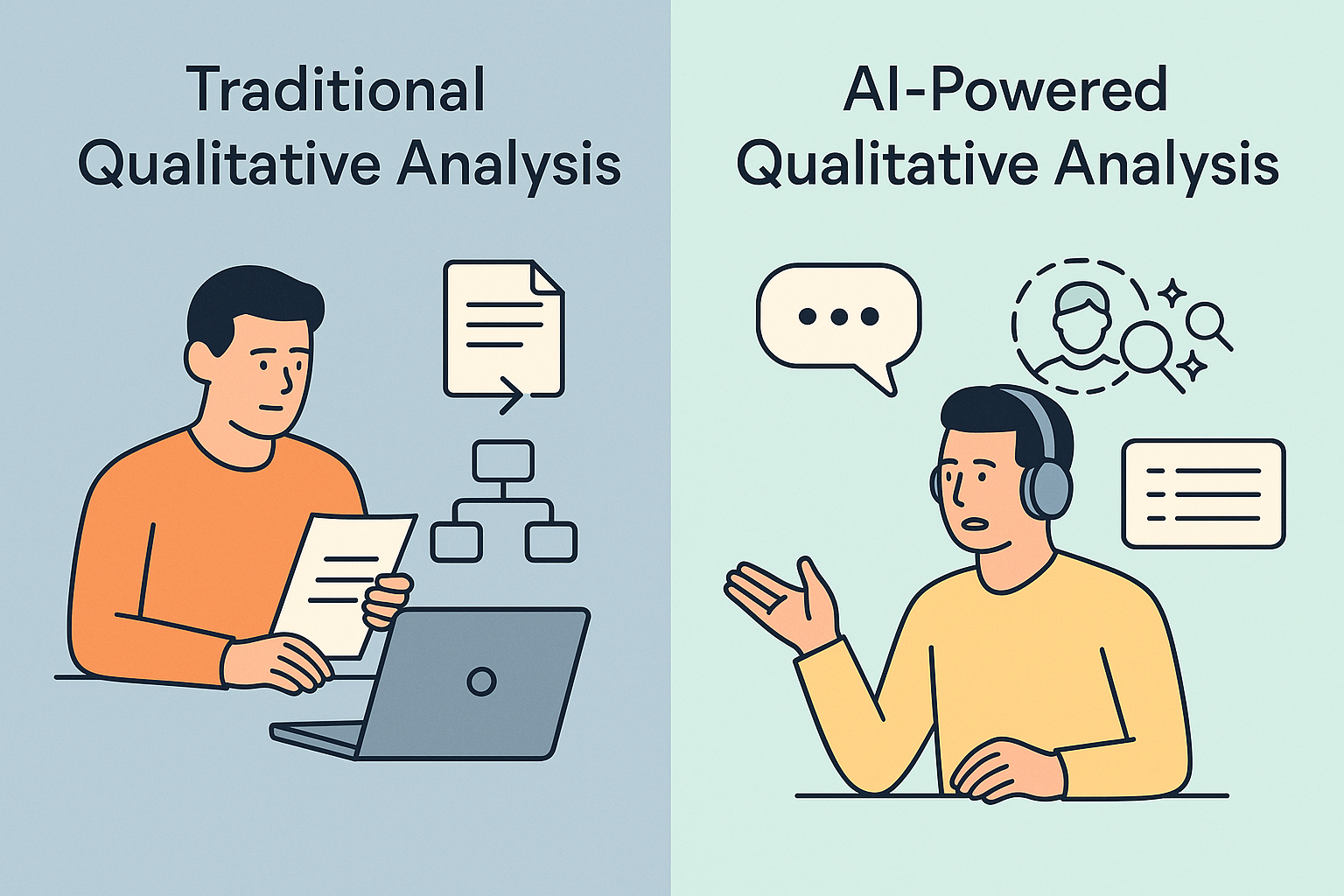
Here’s how the workflow has evolved:
| Stage | Traditional (ATLAS.ti) | AI-Assisted (e.g., UserCall) |
|---|---|---|
| Data Collection | Upload transcripts or recordings manually | Record voice interviews or upload data seamlessly |
| Transcription | Manual import or external service | Auto-transcribed instantly |
| Coding | Manual tagging and hierarchy building | AI auto-detects recurring themes and emotions |
| Theming & Analysis | Manual clustering | AI-assisted pattern recognition |
| Reporting | Manual quotes and exports | Auto-summaries, theme maps, and highlights |
The result?
Researchers can focus on interpretation — not administration.
Example:
A brand researcher analyzing 60 product feedback interviews might use UserCall to instantly extract frustration patterns, emotional tone, and top recurring features users mentioned — then validate and refine those findings instead of starting from a blank slate.
Let’s be clear — ATLAS.ti isn’t obsolete. Far from it.
It still excels when you need:
But for most business, UX, or brand insight teams, those needs are outweighed by the need for speed and collaboration.
Today’s research cycle isn’t quarterly — it’s continuous.
And when you’re running iterative user interviews, testing new features, or comparing sentiment across regions, the time you spend hand-coding in ATLAS.ti could be spent synthesizing insights your stakeholders can act on now.
The next wave of qualitative research is conversational, automated, and voice-driven.
We’re seeing researchers use tools like UserCall to:
It’s not about replacing the researcher — it’s about giving them superpowers.
Instead of building codebooks line by line, they’re asking AI, “What emotions are recurring across these interviews?” and validating the results with their domain expertise.
If you’re doing grounded theory or academic work where every node and memo matters — stay with ATLAS.ti. It’s built for that.
But if you:
Then it’s time to try AI-powered tools like UserCall.
They don’t just analyze data — they help you uncover the story behind it.
ATLAS.ti trained generations of researchers to think in codes, categories, and conceptual depth.
But the modern researcher’s challenge isn’t just coding data — it’s making meaning faster, together.
As insight teams embrace AI, the qualitative researcher’s role becomes more valuable, not less: interpreting the nuance AI can’t see, and telling stories that move people.
So if you’ve been living in ATLAS.ti tabs for years — maybe it’s time to open one new tab.
If this comparison is making you rethink your qualitative stack, the ATLAS.ti vs NVivo vs UserCall in 2026 guide maps out the full picture — or you can jump straight into UserCall and see how AI-assisted analysis handles your own research data.
Still weighing ATLAS.ti against newer AI-driven options? Our guide to the 5 qualitative data analysis tools that actually work lays out how each stacks up beyond just ATLAS.ti. Usercall is built specifically for teams who want AI speed without sacrificing the depth manual coding used to provide.
Related: ATLAS.ti's strengths and where teams struggle · NVivo vs AI qualitative analysis, what's the difference · hidden tradeoffs teams discover too late with Atlas
