
 Table of Contents
“AI audit” now describes two fundamentally different engagements. One examines model risk, data governance, security controls, and regulatory exposure. The other examines whether an organization can identify, adopt, and sustain useful AI-enabled ways of working.
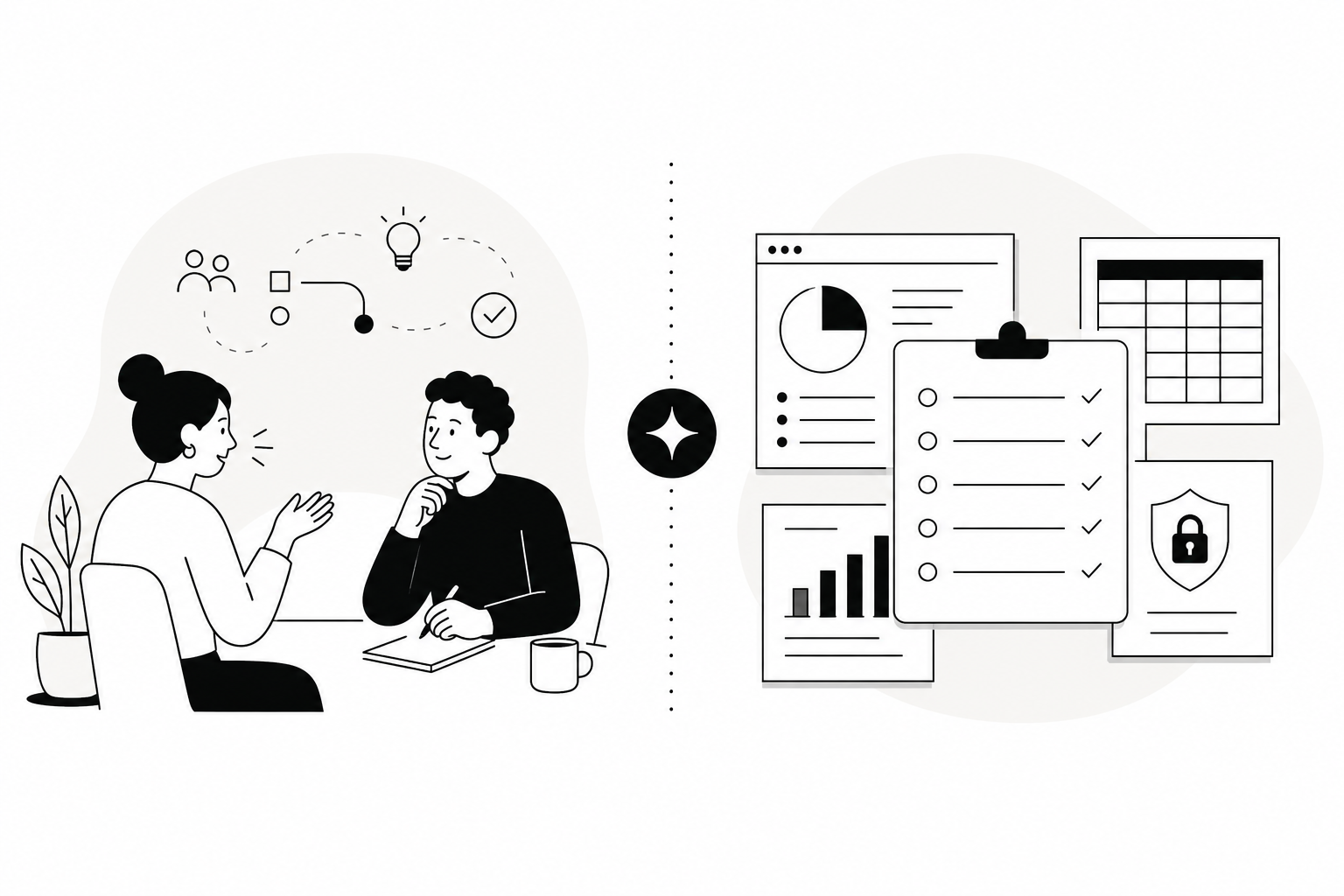
This is about the second kind: an interview-led AI readiness audit. It is a stakeholder-interview-driven diagnostic of an organization’s ability to use AI—not a security, compliance, privacy, or technical model review.
A security AI audit can tell you whether access controls exist, sensitive data could leak, vendors meet requirements, or a model creates unacceptable risk. Those are legitimate questions, but they do not tell you whether AI adoption will work inside the organization.
I regularly see readiness engagements begin with a control checklist because it looks authoritative. The resulting slideware documents policies, approved tools, and risk categories while missing the operating reality: employees cannot access the right data, managers reward the old workflow, or nobody owns the redesigned process.
Compliance evidence is not adoption evidence. A company can have excellent governance and almost no meaningful AI use. It can also have enthusiastic experimentation that creates material security exposure.
These audits can complement each other, but they are not substitutes. If your main question is whether an AI system is safe, lawful, secure, or adequately governed, commission a security or compliance review; if your question is why adoption is stalled and where to act first, run an interview-led readiness audit.
The unit of analysis is not the model. It is the organization around the model. That includes formal structures, informal behavior, decision rights, management signals, and the practical constraints employees encounter during real work.
The interview-led part matters because readiness is rarely documented accurately. A process map may say customer proposals require three approvals; interviews may reveal that experienced account directors bypass two of them, while newer staff spend four hours waiting and then paste confidential material into an unapproved assistant.
A survey can estimate how many people feel confident using AI. Interviews reveal what “confident” means, which task they attempted, why the output failed, what they did next, and which organizational condition caused the failure.
A maturity score compresses disagreement into a number. That makes a slide easier to read but often removes the finding that leaders actually need: different groups are operating from incompatible assumptions.
This is a common pattern: leadership believes the barrier is employee capability, but frontline interviews show teams already have useful prototypes and are simply blocked by unclear approval paths. The recommendation shifts from broad training to a focused governance and workflow pilot.
The contradiction was the insight. An average “readiness score” would have hidden it by blending leadership confidence, legal caution, and frontline experimentation into one respectable but useless figure.
I would rather conduct 12 deliberately varied interviews than 30 conversations with enthusiastic volunteers. Readiness depends on where perspectives diverge, so sampling should follow the workflow and decision chain rather than the organizational chart alone.
Confidentiality also changes evidence quality. Employees will often describe shadow usage, weak manager support, or unrealistic executive expectations only when quotations are reported by role or theme rather than attributed by name.
A fixed-fee engagement gets into trouble when the interview protocol keeps expanding without a decision rule. Every question should earn its place by changing a recommendation, testing an assumption, or explaining a contradiction.
The same discipline applies whether a consultancy runs the audit or an internal leader does it directly. DIY is credible when the owner protects confidentiality, samples beyond friendly colleagues, follows up on vague claims, and separates what participants said from what the owner hoped to hear.
When week-one demand exceeds the available moderator hours, Usercall can provide overflow through AI-moderated interviews with deep researcher controls and research-grade qualitative analysis at scale. The same infrastructure can later place user intercepts at key product-analytics moments to explain the “why” behind adoption metrics, but automation should extend a sound protocol rather than invent one.
The deliverable should let an executive say, “We will redesign this workflow, with this team, under these controls, and measure these outcomes.” If the audit ends at “your organization is level two out of five,” it has diagnosed almost nothing.
Readiness findings must also preserve the boundary with formal assurance. An interview can reveal that employees are uploading sensitive documents to public tools; it cannot verify system configuration, establish regulatory compliance, or certify that a model is secure.
The correct recommendation may therefore include a separate security AI audit. Good readiness work does not pretend interviews can answer technical-control questions—it identifies when those questions are blocking safe adoption and routes them to the right specialists.
If you need assurance about models, vendors, data handling, security controls, or regulatory obligations, commission a security or compliance AI audit. If you need to decide where AI can create value, why teams are not adopting it, and what organizational changes must happen first, commission an interview-led AI readiness audit.
For consultancy principals, this distinction prevents a sold readiness engagement from drifting into technical assurance you are not staffed or insured to provide. For in-house owners, it prevents governance checklists from becoming a substitute for listening to the people whose workflows must actually change.
Define the decision, draw the scope boundary, interview across the operating system, and trace every recommendation back to evidence. That is a readiness audit; everything else is either a different professional service or slideware wearing the same name.
Usercall runs AI-moderated user interviews that collect qualitative insights at scale, with the depth of a real conversation and without the overhead of a research agency. Use it to extend stakeholder interview capacity while retaining control over the protocol, follow-ups, and analysis.
