
 Table of Contents
Most codebooks fail before the first transcript is fully coded. The team treats coding like labeling quotes, not like building an analytic instrument. Then three researchers code the same interview three different ways, the findings deck turns into a word cloud with prettier fonts, and nobody can explain how “confusion,” “friction,” and “low confidence” became a strategic recommendation.
A weak codebook is usually too broad, too vague, or too early. Teams rush to create a giant list of labels after reading two interviews, then keep adding edge-case codes until the whole thing collapses under its own weight. The result is false rigor: lots of tags, very little insight.
The most common mistake is confusing topical sorting with analysis. “Pricing,” “onboarding,” and “support” are not bad codes, but they rarely explain behavior. If your codebook only tells you what users talked about, not why they struggled, chose, hesitated, or adapted, you’re organizing transcripts, not doing qualitative research.
I saw this firsthand on a 9-person product team working on a B2B workflow tool. We had 28 usability and concept interviews, two tight deadlines, and three stakeholders each pushing their own vocabulary. Our first codebook had 47 codes, and half of them overlapped. We cut it to 18 by forcing every code to answer a behavioral question, and suddenly the themes became decision-ready: not “navigation issues,” but “users bypass guided setup when they fear making irreversible changes.”
Another failure point is creating codes without inclusion and exclusion rules. If one researcher uses “trust concern” for skepticism about AI outputs, and another uses it only for privacy objections, your analysis is already drifting. A code without boundaries is not a code.
The best codebooks are built backward from the decision the research needs to support. Before I write a single code name, I ask: what kind of pattern would matter here? Adoption barrier, unmet need, coping behavior, expectation gap, perceived value, trust threshold. That framing changes everything.
If you’re using Braun and Clarke-style thematic analysis, your codebook should help you move from data features to meaning patterns. That means your codes need to be specific enough to capture recurring signals, but not so narrow that every quote gets its own label. I want codes that travel across participants.
For example, in a study on a consumer finance app, “afraid of overdraft fees,” “checks balance repeatedly,” and “waits for paycheck before transfer” could all eventually support a stronger theme around vigilance under uncertainty. If you stop at surface labels, you miss the pattern tying those behaviors together.
This is also where your data collection method matters. Interviews, diary studies, intercept surveys with open text, and moderated usability sessions produce different kinds of evidence. If you need a clearer view on method fit, I’d start with qualitative data collection methods. And if you’re collecting large volumes of interview data, Usercall is one of the few tools I’d actually recommend because it combines AI-moderated interviews with researcher controls strong enough to preserve study intent, then supports research-grade qualitative analysis at scale.
This structure sounds simple, but it prevents 80% of coding drift. The inclusion and exclusion rules are the workhorses. Without them, teams start applying codes based on vibes, and vibes do not scale.
Here’s a practical example. Say your code is “fear of making a mistake.” The definition might be: user expresses concern that an action could cause a negative outcome they can’t easily reverse. Inclusion: hesitation tied to risk, permanence, or financial/operational consequences. Exclusion: generic confusion about where to click; that belongs under “interface uncertainty” unless the participant explicitly links it to risk.
I learned to add the analytic note after a painful project with a 14-person insights org studying enterprise admin workflows. We had 63 interviews across three customer segments and a codebook that was technically clean but strategically flat. Once we added a one-line note explaining why each code mattered, junior researchers coded more consistently and senior stakeholders could see the bridge from evidence to implication.
If you want a broader walkthrough of coding approaches, content analysis in qualitative research is worth reading alongside this. It’s especially useful if your stakeholders keep asking for counts before the analysis is ready for counting.
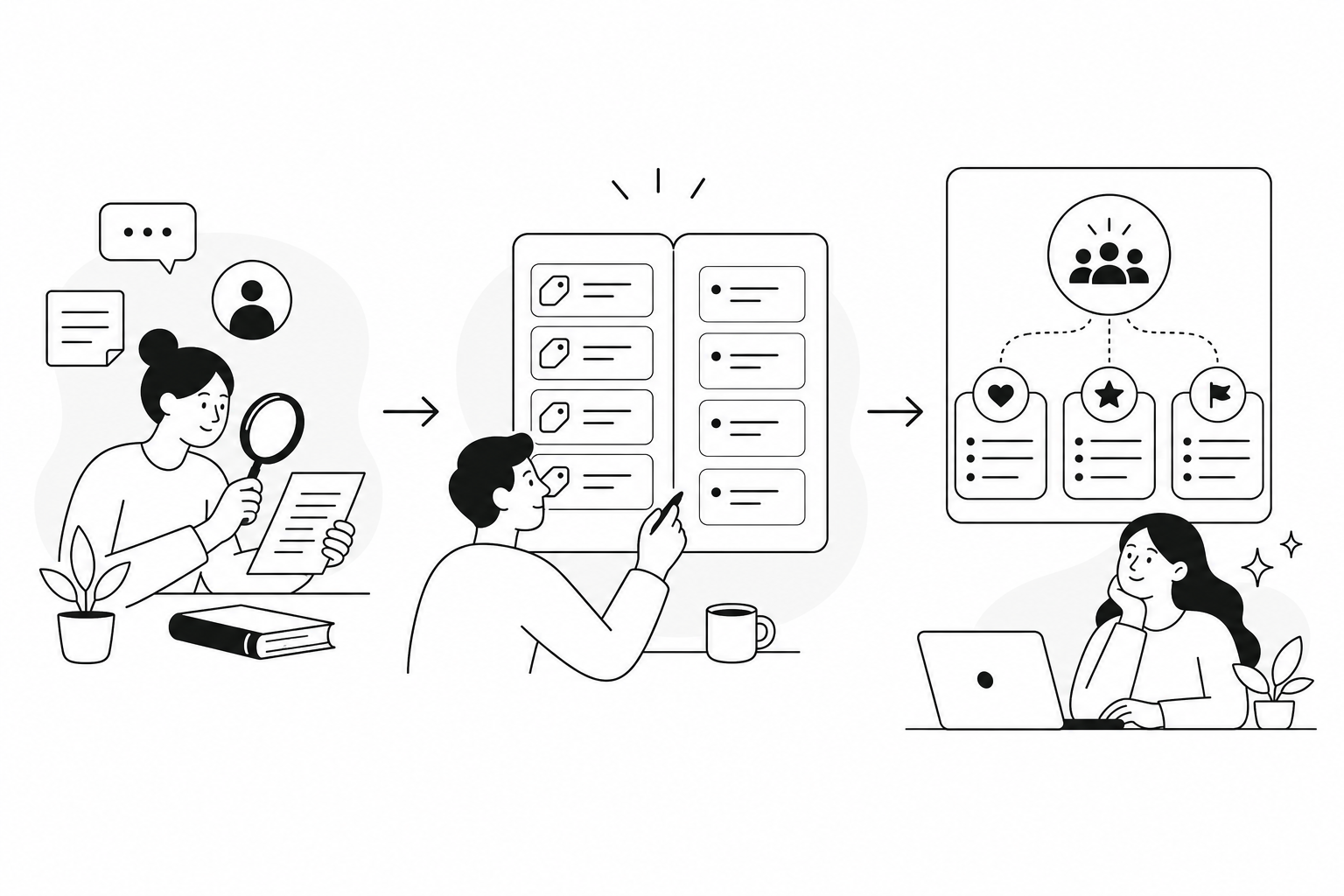
Good coding is iterative, not heroic. I do not try to finalize a codebook after a single read-through, and neither should you. Strong codebooks emerge through multiple passes because your understanding of the data changes as you encounter contradiction, repetition, and edge cases.
In Braun and Clarke’s method, this maps cleanly onto the movement from familiarization to coding to generating initial themes. The trap is treating coding as the finish line. It’s not. Coding is just how you build the raw material for themes.
On a recent study for a PLG SaaS product, we used in-product intercepts to recruit users right after a sharp activation drop. The team assumed setup friction was the story. But once we coded 41 short interviews in passes, the dominant pattern wasn’t friction alone. It was expectation mismatch: users thought they were starting a trial, but the product was asking them to configure a live environment. That distinction changed the onboarding roadmap.
This is exactly where Usercall is useful. Triggering user intercepts at key product analytic moments lets you capture the “why” behind a metric drop while the experience is still fresh. Then you can analyze those interviews at scale without turning the study into a month-long manual coding project.
The biggest analytic mistake I see is calling a cluster of similar codes a theme. It usually isn’t. A theme needs a central organizing concept. It should tell me something important about the patterned meaning in the data, not just list topics that appeared often.
Take these codes: “asks manager before acting,” “avoids advanced settings,” “repeats same safe workflow,” and “wants confirmation before publishing.” Those do not automatically form a theme called “hesitation.” That’s still descriptive. A stronger theme might be: users protect themselves from perceived system risk by narrowing their behavior to reversible actions. Now we have a mechanism, not a pile.
This is where I borrow heavily from Braun and Clarke: review candidate themes against coded extracts and the full dataset, then refine the story each theme tells. If a theme can’t explain why several codes belong together, it’s not ready. If it overlaps too much with another theme, force the distinction.
If you’re deciding whether thematic analysis is even the right frame, read grounded theory vs thematic analysis. I’ve watched teams pick grounded theory because it sounded more sophisticated, then drown in unnecessary methodological ambition.
A codebook is not a static artifact. It’s a working model of how your team interprets evidence. That means it should be stable enough for consistency and flexible enough to improve as new data arrives. If you lock it too early, you miss emerging patterns. If you keep changing it without documenting why, your analysis becomes impossible to trust.
My rule is simple: revise the codebook deliberately, not continuously. Batch changes after a small set of transcripts, note what changed, and recode earlier material only when the update materially affects interpretation. That keeps the process disciplined without pretending human analysis is mechanical.
Tool choice matters here more than most teams admit. I’ve seen expensive qualitative software slow researchers down because it encouraged endless code proliferation and made memoing awkward. If you’re sorting through options, read the best computer programs for qualitative data analysis. My bias is practical: use the setup that helps you move from evidence to decision faster, with fewer handoff losses.
If you remember one thing, make it this: codes are not the insight. They are the scaffolding. The real job is turning repeated pieces of meaning into a theme that explains user behavior in a way your product, design, or research team can act on.
A codebook is only as useful as the tool you build it in — manually maintaining one across dozens of transcripts gets messy fast. If you want to see how modern software handles codebooks, coding, and theme generation without the spreadsheet juggling, check out our breakdown of the top 5 qualitative data analysis tools that actually work. Usercall was built to keep coding and theme-building in one place, so your codebook stays organized as your project grows.
Related: the 7-step thematic analysis coding method · inductive vs deductive coding approaches · the Braun & Clarke 6-step method in full
